A question we receive all the time at Advertiser Perceptions is,
“What is an appropriate, representative sample size for a study surveying advertisers?”
This question is a good one, and it’s the right one to ask: As many companies are often consumer-first in their brand research efforts and then look to understand the advertising side of their businesses, there can be misconceptions about applying similar B2C methodologies to B2B research. The biggest: an assumption that B2B sample sizes should match B2B sample size.
Consider this: Consumer research projects typically start with a sample size of 1,000 people, and many projects have sample sizes in excess of 10,000. That makes sense when there are over 340 million people living in the United States and billions more across the globe. Companies looking for insights about the overall population or specific consumer demographics need a large enough sample that can effectively reflect the desired population.
But for B2B research, advertising research in particular, we aren’t starting with a universe that’s in the millions. In the US, for example, the total population of mid- to senior-level
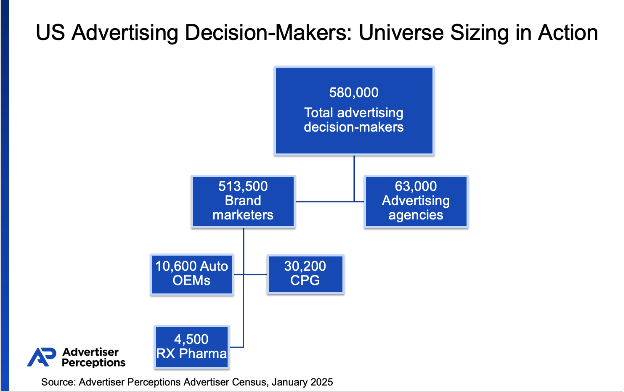
decision-makers or influencers over media buying and advertising in the US is 580,000.
That’s roughly one-thousandth the size of the total consumer population to start.
Of course, that’s just the total population: Segmenting to specific industries, media channel usage, size of company, etc. very quickly reduces the total population. As such, we’re not talking sample sizes in the thousands, unless we’re looking to reach a very broad swath of decision-makers across multiple markets. Instead, most B2B advertising research can achieve representative sample sizes with just a few hundred advertisers, or even less, depending on the specificity of the study.
Consider the fact that over a quarter of the brand-side marketer employment exists in industries primarily composed of SMBs such as automotive dealerships, insurance agencies, law firms, real estate offices, etc. It’s also critical to know that many industries that account for a large amount of advertising spend employ a very small number of marketers on the brand side. The prescription pharmaceutical industry employs roughly 4,500 people in total in advertising decision making roles on the brand side, Auto OEMs only employ roughly 10,600 people, and CPG (a very diverse category) employs only 30,200 people in these roles. Having an understanding of these types of insights is key to ensure a proper handle on the total universe of respondents that companies can target.
For example, a media seller looking to reach TV advertising decision-makers in the pharmaceutical, auto, and CPG industries could use 40 people in each group as a representative sample, provided they are reaching the correct people. That’s because combined, the total number of decision-makers in these three industries is just 45,300, but the actual TV advertising decision-makers within these groups is even smaller.
While 40 per vertical (or n=120) might seem small to the B2C researcher, it actually represents a much larger share of the total population than an n=1000 or even n=10,000 consumer study.
Here’s the math: Even if we were to assume that every decision-maker in this subset had TV advertising responsibilities, a sample size of 120 respondents as a representation of 45,300 would mean 0.26% of the total population or roughly 1 in 400. In contrast, a sample size of 1,000 with a total population of 340 million is actually 0.00029% of the population, or 1 in 340,000!
The bottom line: Having a handle on the universe of decision-makers is critical to ensure companies are building an accurate, representative sample of the population they care about. Here, more isn’t always more. In fact, promises of reaching hundreds of decision-makers for a universe that may at most total 1,000 people is a clear red flag that something may not be right, especially in markets outside of the US where most advertiser universes are even smaller
