On April 2nd the Trump administration announced “reciprocal tariffs” on imports from most foreign countries. Reciprocal tariffs begin at 10%, while many major trading partners will see higher duties based on bilateral trade imbalances. Imports from the EU, China, Japan, and South Korea face incremental import duties of 20%, 34%, 24%, and 24%, respectively. Depending on the country, these may be in addition to tariffs already on the books.
Today, US businesses are frenzied trying to understand the impacts to their day-to-day practices and long-term livelihoods.
What does this mean for the advertising industry? Our head of forecasting and VP business intelligence, Eric Haggstrom, breaks it down:
Macro Effects:
Tariffs of this magnitude are a big pivot. I can’t overstate how much of a shift this “reciprocal tariff” policy is from the past 80 years of US trade policy. Free trade had been the policy for two reasons: American consumers and businesses can purchase low-complexity goods and goods we do not manufacture more cheaply than if they were solely reliant on domestic production. Second, free trade is good for geopolitical relationships: Countries that trade and have deep economic ties do not go to war. During his first presidency, Trump had instituted a number of tariffs, which Biden had either continued or expanded, but the magnitude here is much higher. Trump’s advisors in his previous term openly stated a future need to decouple the US economy from Chinese manufacturing, but were unclear on the timeline. Unless a deal is made, this is it.
These newly announced tariffs are significantly higher than what I or most market watchers were expecting AND they are in addition to other tariffs. “Reciprocal” tariff rates were set primarily based on the bilateral trade deficits between the US and trading partners. While the stated goal is to reduce barriers that other countries place on US goods, the implied goal is less about reducing tariffs on US exports and more about encouraging partners to buy more US-made products. Expect reduced tariffs in exchange for purchase commitments by partners for American agricultural products, oil, liquified natural gas, weapons of war, and other products that are typically bought at the government level.
The only clear “winners” right now are companies that rely only on domestic production, including for their inputs, and have the potential to be sold in bulk to other governments. Oil and gas, defense contractors, and hedge funds who can make money in the current volatile environment are the only industries that immediately come to mind. Notably, none of these are consumer goods nor do they spend heavily on advertising. Companies who already have most or all of their production in the US will see an immediate tailwind as well.
Retailers will see the most acute effects fairly immediately. Production costs will go up dramatically for brands reliant on overseas production. Some of these costs will be pushed to the end retailer who will either have to raise prices to consumers or eat into their own (thin) margins. Costs to consumers will go up even more dramatically for Chinese based brands bought via online marketplaces and Chinese retailers who benefit heavily from the de minimis trade exemptions that are being phased out. Margins can only compress so much, so marketing dollars will likely be a casualty.
A quick note on the math behind the tariffs: Don’t expect consumers prices on foreign-made goods to rise by the tariff amount. The actual import value is much lower and is a fraction of the price paid by consumers. We assume brands will let tariffs and duties eat into their margins, likely deciding to cut costs in other ways (like marketing).
Ad Industry Effects:
Social, search, and retail media will be the most immediate “losers” given they overindex on performance advertisers and brands based in China. As of our market outlook update finalized in late March, we estimated total US ad spend YOY growth will be flat in Q2 and Q3 2025; this range may now be somewhat optimistic, but we anticipate it won’t fall further than 5%. Most brands will take a wait and see approach, rather than a pause on media.
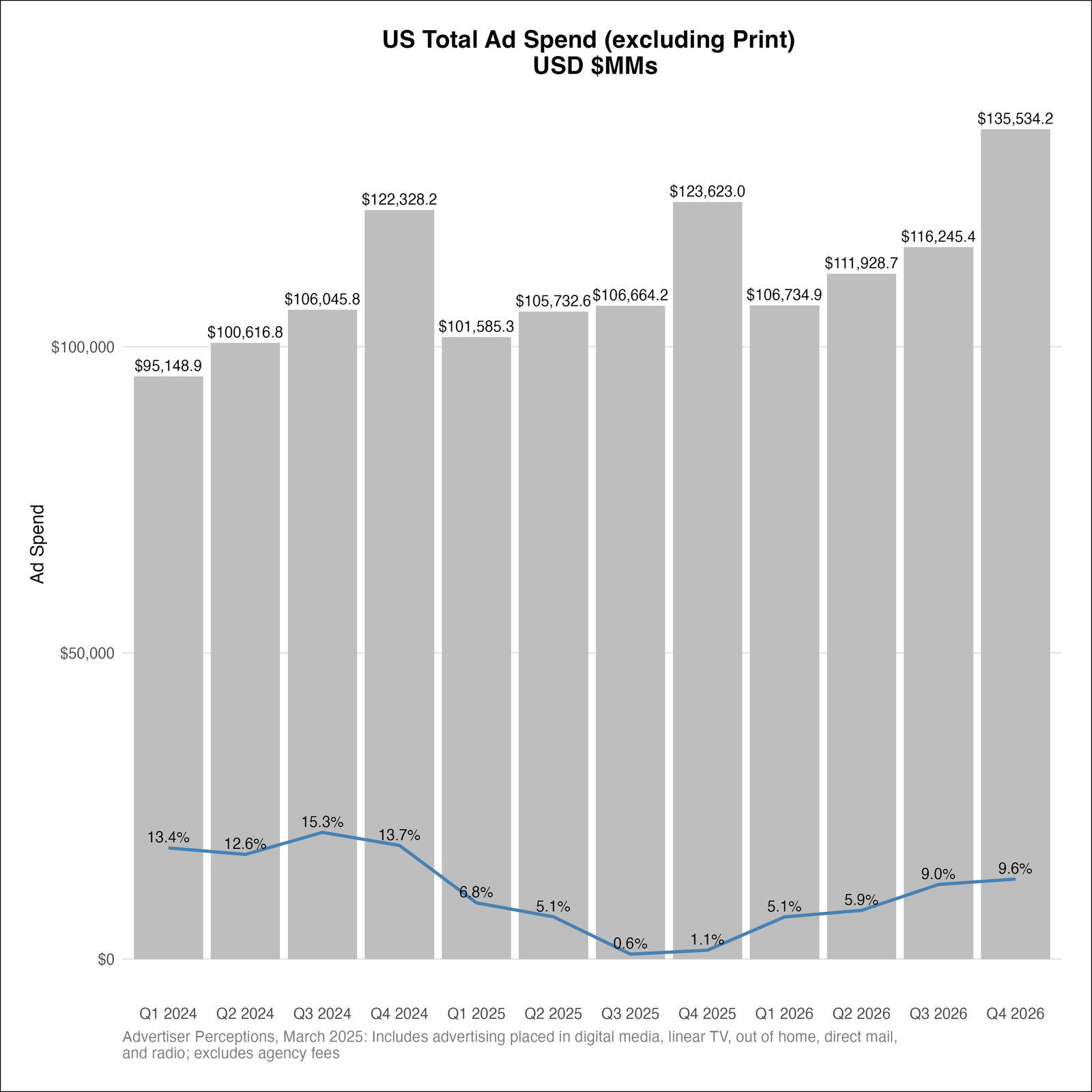
Retail media will see immediate headwinds due to margin compression on the supplier side, which overindexes to Chinese brands. CPG-focused retail media platforms will likely be more resilient due to the fact that more of their suppliers have US-based production. Additionally, retailers themselves account for ~20% of the ad market, and the bulk of spend in performance-focused channels outside of retail media. Everyone else (auto, CPG, pharma, financial services , consumer + B2B tech, etc.) will be touch and go for the next 6 months but will not see the same headwinds as retail.
Performance vs. Brand: Historically, brand advertising has struggled in tough economic times, while performance has been more resilient. This will be the case this time, but the brands with the largest performance budgets (retailers) will be impacted most severely overall.
While we expect individual brands will focus more on performance vs. brand, we anticipate brand spend will be more resilient than performance spend at the macro level. The brands that spend more heavily on upper-funnel advertising will be more insulated from the tariffs in general.
Despite clear anticipated headwinds, advertisers had indicated strong expected growth in media budgets to begin the year. Advertiser Perceptions’ latest Macroeconomic Effects and Perceptions study, fielded in mid to late February indicated that 40% of advertisers planned to increase their paid media budgets in 2025 relative to 2024. Only 8% were planning decreases.
